
Post-graduate play therapy education for mental health professionals.
Meraki Institute of Learning by Tanager’s Center for Play Therapy provides professional development designed to strengthen play therapy knowledge, skills, and clinical application. Training opportunities range from foundational learning to intermediate, advanced, and specialty topics.
APT Approved Provider 16-457
2026–2027 Training Series
Explore four post-graduate play therapy trainings designed to build skills from foundational practice through intermediate, advanced, and specialty applications.
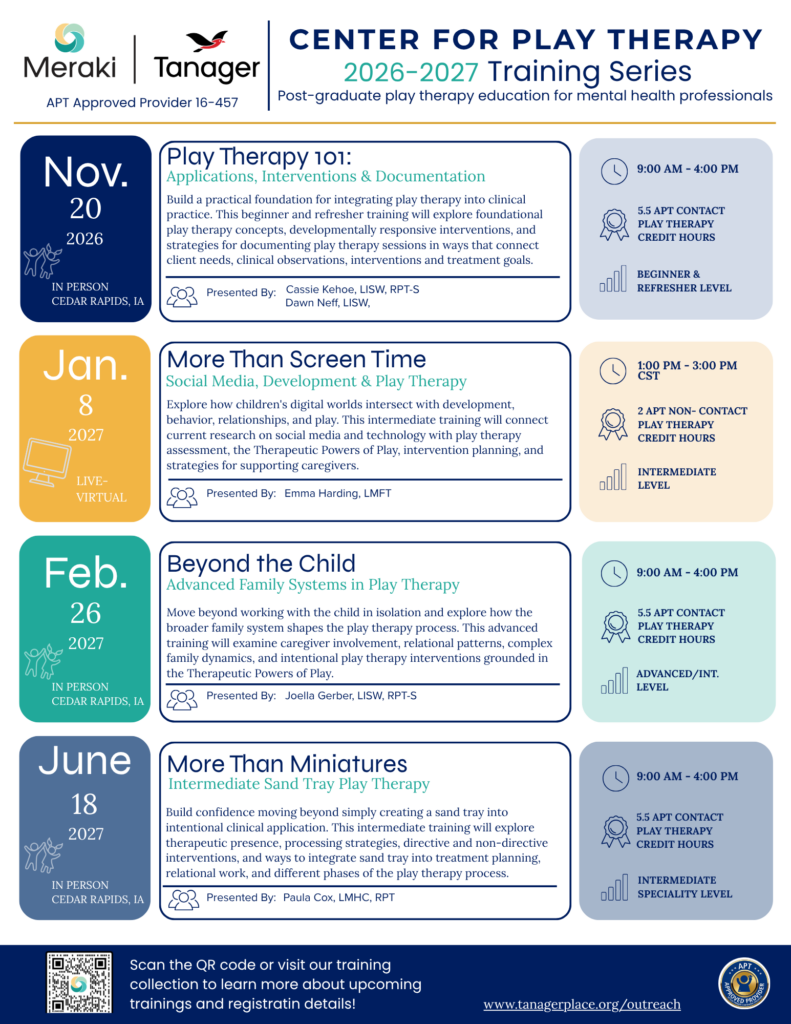
Training Details
Play Therapy 101: Applications, Interventions & Documentation
November 20, 2026
Check-In: 8:30 AM | Training: 9:00 AM–4:00 PM
Live, In Person | Cedar Rapids, Iowa
5.5 APT Contact Play Therapy Credit Hours
Beginner & Refresher Level
Presenters
Cassie Kehoe, LISW, RPT-S
Dawn Neff, LISW
Training Description
This workshop is designed for therapists just getting started in play therapy as well as therapists seeking to refresh their play therapy awareness, understanding, and application. This workshop will cover a basic history and theoretical concepts specific to both directive and non-directive play therapy. Participants will be introduced to toys and materials needed to set up a play therapy room. Participants will learn play therapy interventions such as restating content, reflecting feelings, metacommunication, limit setting, and therapeutic metaphors. Participants will learn common treatment phases for play therapy and practice creating goals, objectives, and interventions according to the phase of treatment. Participants will also practice creating sample progress notes based on role play
Learning Objectives
After attending this workshop, participants will be able to:
- Discuss the history, benefits, and risks of play therapy.
- Explain theoretical concepts specific to both directive and non-directive play therapy.
- Identify materials needed to set up a play therapy room and practice basic interventions such as tracking, restating content, and reflecting feelings.
- Demonstrate advanced interventions including metacommunication, limit setting, and therapeutic metaphors.
- Create treatment goals, objectives, and interventions aligned with the phases of play therapy treatment.
- Develop sample documentation and progress notes based on role play practice.
Training Schedule
8:30–9:00 AM — Check-In & Registration
9:00–10:30 AM — Instruction
10:30–10:45 AM — Break
10:45 AM–12:00 PM — Instruction
12:00–1:00 PM — Lunch
1:00–2:30 PM — Instruction
2:30–2:45 PM — Break
2:45–4:00 PM — Instruction
Location
Tanager – Estle Center
1030 5th Ave SE
Cedar Rapids, IA 52403
Registration
$140 | Register for Play Therapy 101
More Than Screen Time: Social Media, Development & Play Therapy
January 8, 2027 | 1:00–3:00 PM CST
Live Virtual
2 APT Non-Contact Play Therapy Credit Hours
Intermediate Level
Presenter
Emma Harding, LMFT
Training Description
Children’s digital experiences do not exist separately from their development, relationships, emotions, or play. This intermediate training explores how social media, gaming, online communication, and other digital experiences may influence regulation, identity development, peer relationships, attention, sleep, belonging, and behavior. Participants will consider how a child’s digital world can inform play therapy assessment and case conceptualization, connect digital experiences to the Therapeutic Powers of Play, and identify developmentally responsive play therapy interventions and caregiver support strategies.
Learning Objectives
After attending this workshop, participants will be able to:
- Identify at least three developmental and relational factors associated with children’s social media and digital experiences that may inform play therapy assessment and case conceptualization.
- Apply the Therapeutic Powers of Play to select play therapy interventions addressing needs related to regulation, identity, belonging, relationships, or digital experiences.
- Develop at least two play therapy-informed strategies for engaging caregivers in conversations about children’s technology and social media use.
Training Schedule
1:00–1:15 PM — Children’s Digital Worlds Through a Developmental Lens
1:15–1:45 PM — Development, Regulation, Relationships & Digital Experiences
1:45–2:15 PM — Digital Experiences in Play Therapy Assessment & Case Conceptualization
2:15–2:45 PM — Therapeutic Powers of Play & Intervention Planning
2:45–3:00 PM — Supporting Caregivers & Clinical Application
Delivery Information
Live virtual training. Access information will be provided to registered participants prior to the training.
Credit Requirements
Participants must meet attendance and identity-verification requirements and successfully complete the required post-test to receive non-contact play therapy credit.
Registration
$40 | Register for More Than Screen Time
Beyond the Child: Advanced Family Systems in Play Therapy
February 26, 2027
Check-In: 8:30 AM | Training: 9:00 AM–4:00 PM
Live, In Person | Cedar Rapids, Iowa
5.5 APT Contact Play Therapy Credit Hours
Intermediate / Advanced Level
Presenter
Joella Gerber, LISW, RPT-S
Training Description
Play therapy takes place within a larger relational system. This intermediate and advanced workshop explores how family structure, caregiver relationships, patterns of interaction, attachment experiences, culture, and environmental stressors can influence a child’s presenting needs and the play therapy process. Participants will examine different roles caregivers may hold within treatment, identify relational and systemic patterns that emerge in play therapy, and practice intentionally matching play therapy interventions to the needs of the child and family system. Complex case examples will support application of the Therapeutic Powers of Play, family systems concepts, and culturally responsive clinical decision making.
Learning Objectives
After attending this workshop, participants will be able to:
- Analyze child and family concerns using family systems concepts to inform play therapy case conceptualization and treatment planning.
- Differentiate at least three caregiver roles within play therapy and select an appropriate level of caregiver involvement based on clinical need.
- Identify relational and systemic patterns observed during play therapy while distinguishing clinical observation from unsupported interpretation.
- Apply the Therapeutic Powers of Play to select interventions targeting regulation, attachment, communication, and family relationship needs.
- Develop culturally responsive play therapy strategies that consider family structure, identity, beliefs, socioeconomic context, and differing definitions of parenting and connection.
- Formulate an integrated play therapy treatment approach for a complex family case using child, caregiver, relational, and systemic information.
Training Schedule
8:30–9:00 AM — Check-In & Registration
9:00–10:30 AM — Family Systems Foundations Within Play Therapy
10:30–10:45 AM — Break
10:45 AM–12:00 PM — Caregiver Roles, Attachment & Relational Patterns
12:00–1:00 PM — Lunch
1:00–2:30 PM — Therapeutic Powers of Play & Intervention Matching
2:30–2:45 PM — Break
2:45–4:00 PM — Complex Family Case Application
Location
Tanager – Estle Center
1030 5th Ave SE
Cedar Rapids, IA 52403
Registration
$140 | Register for Beyond the Child
More Than Miniatures: Intermediate Sand Tray Play Therapy
June 18, 2027
Check-In: 8:30 AM | Training: 9:00 AM–4:00 PM
Live, In Person | Cedar Rapids, Iowa
5.5 APT Contact Play Therapy Credit Hours
Intermediate Specialty Level
Presenter
Paula Cox, LMHC, RPT
Training Description
Move beyond simply creating a sand tray and build greater intentionality in the clinical use of sand tray within play therapy. This intermediate workshop explores therapeutic presence, the structure and process of a sand tray experience, approaches to processing client-created trays, and both directive and non-directive applications. Participants will practice selecting sand tray play therapy interventions based on client needs, treatment goals, relational dynamics, and phase of treatment while maintaining developmentally responsive and ethically grounded clinical practice.
Learning Objectives
After attending this workshop, participants will be able to:
- Describe the historical foundations and clinical role of sand tray within play therapy practice.
- Demonstrate how to introduce, facilitate, and close a sand tray play therapy experience while maintaining therapeutic presence.
- Apply developmentally responsive processing strategies to explore a client’s sand tray without imposing unsupported interpretation.
- Differentiate directive and non-directive sand tray play therapy approaches and identify clinical indications for each.
- Develop sand tray play therapy interventions that align with client needs, treatment goals, relational work, and phase of treatment.
- Integrate information from a sand tray experience into play therapy case conceptualization, treatment planning, and documentation.
Training Schedule
8:30–9:00 AM — Check-In & Registration
9:00–10:30 AM — Foundations, Therapeutic Presence & the Sand Tray Process
10:30–10:45 AM — Break
10:45 AM–12:00 PM — Experiential Sand Tray Practice & Processing
12:00–1:00 PM — Lunch
1:00–2:30 PM — Directive & Non-Directive Sand Tray Play Therapy
2:30–2:45 PM — Break
2:45–4:00 PM — Treatment Planning, Relational Work & Clinical Application
Location
Tanager – Estle Center
1030 5th Ave SE
Cedar Rapids, IA 52403
Registration
$140 | Register for More Than Miniatures
Pricing & Registration
Pricing & Registration
Register for one training or attend the full 2026–2027 series.
Individual In-Person Trainings
$140 each
Live Virtual Training
$40
Full Series Pass
$400
Includes all four trainings and up to 18.5 APT play therapy credit hours.
Save $60 compared with individual registration.
Therapy Credit & Registration Information
APT Approved Provider 16-457
Play therapy credit is only awarded to mental health professionals. Graduate students enrolled in a graduate mental health program and individuals who hold a graduate mental health degree may also be eligible to receive play therapy credit.
Cancellation & Refund Policy
Payment is due at the time of registration. Cancellations made at least 30 days before the training will receive a full refund of the registration cost. Cancellations made less than 30 days before the training may transfer their registration fees to an alternative course or request a partial refund. No-show registrations are not eligible for refund or transfer. All refunds and transfers are at the discretion of Meraki Institute of Learning and Tanager.
Questions, Accessibility & Concerns
For questions, registration assistance, accessibility needs, accommodations, or concerns regarding a training, contact Meraki Institute of Learning at merakiinstitute@tanagerplace.org